
THE 'SPECIAL' IS A true representation of free expression, basically its a one-off design built for the satisfaction of its designer, constructor or sponsoring owner.
The founder of Dunsmore Motor Traction is a true vintage car enthusiast who started out building his own specials and giving a helping hand to a number of Midland enthusiasts in building theirs.
Bill Hines, set out to build a sporting car that reflected his taste for nostalgia. Inevitably, local media exposure of his first 'special', caused the phone to ring - the final statement from the caller being "Can you build one for me?" Any serious thoughts of adding the Hines name to well over 100 motor car manufacturers in the 100 plus years list of Coventry manufacturers was furthest from his mind.
The Hines family's reliance on the motor industry goes back to the 1920s, a time when motor manufacturers - well established in the Coventry area - attracted labour from all over the country. Bill tells a story of those days when London resident Percy McClure, one of Riley's 'works' drivers, offered Bill's father a job which meant initially working away from the Hines London home. Jack was picked up by McClure at Marble Arch every Monday morning at 6.00 am in a Riley Nine. One hundred miles later, just before 8.00am, McClure and Hines 'clocked in' at Riley's Coventry factory, having negotiated the heavy traffic on the old A5.
Said Bill: "Percy McClure was a heavy smoker and took both hands off the wheel, to light up, insisting that my father steered the car from the passenger seat, when it was flat out. Dad was scared stiff - he never did drive and never held a licence" Bill recalls. "Perhaps these journeys and the drive back on Friday afternoons put him off driving, for life!"
The Hines family Bill home in Coventry was an atmosphere always heavy with motor sport and motor industry chat. "Dad went everywhere with the Riley Works Team, a great enthusiast and a loyal employee." On reflection the Hines brothers Bill and Eric, a keen and accomplished sports car restorer, realise that this was the start of their indoctrination and life long addiction to sporting cars.
For Bill, the first available route to mobility in his 'teens was the acquisition of motor cycles, many of them for less than a fiver, graduating, not unnaturally, to very inexpensive pre-war Rileys. This, coupled with an engineering apprenticeship and the home build of grass track motorcycle specials only served to increase the obsession. "We only bought complete transport when necessary, Eric and I always wanted to build them rather than buy them. If something took my eye I always wanted to build one to beat it."
A long list of cars and 'bikes' passed through Bill's hand's a particular favourite being a 500cc J.A.P. engined MK 4 Cooper single seater used in hill climbs. Also in the list was a Jaguar engined Marendaz tourer and a fearsome cable braked Jaguar special, both vintage in their style, the latter totally devoid of good road manners.
National Service was followed by a spell in the aircraft industry, then to the setting up of a garage business in the early Sixties. Throughout this period of building a business, principally engaged in vehicle repair, there was little or no time available for special building.
With the move to Dunsmore Heath, between Coventry and Rugby Bill was determined to find time to build another special. The basis, a £500 Vauxhall provided a complete front suspension unit, VX4/90 engine gearbox and rear axle, running on pre '39 17" Rover wire wheels. "With a low overall weight and not more than 3" of tyre width and even less rubber on the road, initially it was quite a handful. In correcting its faults I learnt a lot about ride and handling. If nothing else it looked the part."
Bill was only partially satisfied. The vintage effect created by cycle type wings, aero screens, strapped bonnet and the outside handbrake was spoilt by exposed independent front suspension. He was insistent that any car that followed must have a beam front axle , leaf springs and real vintage aesthetics.
Hines Chassis No 2. was truly hand crafted. "Every chassis component was hand cut to length, including all the big box section steels. The adoption of the Vauxhall Ventora engine caused a bit of stir, it still does, but it's a gutsy, no nonsense, inexpensive and very durable motor. Dunsmore have supplied twin carb versions of the Ventora and motors with three 2" SUs. To this day Bill bemoans the fact that he never realised his ambition to build a six cylinder "special" with six Amals. Even in single carb form the Ventora engined Dunsmore is still good for over 105mph at 4000 rpm - in spite of the weight and its vintage brick-like aerodynamics. The other useful feature of the Vauxhall engine and the six cylinder Jaguars is the opportunity to fit Laycock de Normanville Overdrive, which with the right axle ratio gives the Dunsmore a long, long, stride.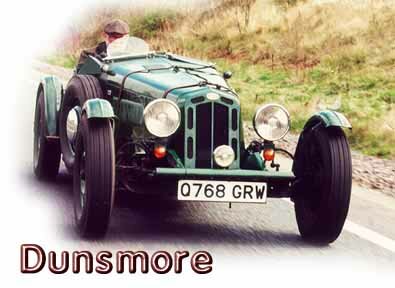
As the story progressed, not only the base specification of Dunsmore was emerging, but how it was designed and built very much in the vintage spirit.
Chassis 2 featured underslung main members at the rear, although two cars were subsequently built with chassis rail over the rear axle, Dunsmore returned to an underslung frame at the rear. Bill admits that a total removal of the live axle takes a little longer, but the differential assembly can be removed with the axle in place. At the front, the frame members or dumb irons sweep over the front beam axle in traditional fashion on all Dunsmores.
The main side members extend rearwards - sweeping under and then up having passed the rear axle centreline, with the rear mounting of the rear leaf springs at their extremity. Others have incorrectly described the frame as a multi tube space frame, the combined chassis and sturdy body frame creating this impression. The main members are 80 x 40 x 3mm, joined at the front by a tubular cross member which carries the front spring brackets. The substantial front engine bearer combines with cross members spaced along the chassis at intervals, to the rear cross member, to produce a conventional ladder frame.
The jig built, welded frame, gains extra strength and torsional rigidity from the multi tubular seat fixing support frame, added to by a sturdy fixed scuttle frame and body side frames of 1 inch square tube, plus steel sheet welded into the frame in the cockpit, footwell and scuttle areas. The whole is a very solid structure with tubes converging at points which lend themselves readily to the firm mounting of additional bracketry should a passenger protection bar be required. A full windscreen mounting can be provided, but as yet only one Dunsmore has appeared in this form, other owners having opted for aeroscreens. Hardy folks these Dunsmorians!
There's a marked absence of aluminium and only one GRP moulding, the boot lid. The scuttle covering is made up of two layers of 4mm thick plywood, bonded together and covered in vinyl, so far a dark racing green covering predominates. The high steel content of the chassis body frame and body panels, including the bonnet and radiator shell calls for the whole structure to be heavily primed in a red oxide primer. The chassis frame receives an additional finishing coat, in black gloss. The remaining items, bonnet, radiator shell and all other surfaces above the chassis line are finished in the chosen body colour. Any final colour surface coating application is easily quality controlled the work being carried out by a business immediately adjacent to Dunsmore's premises.
The solidity built into the chassis body unit together with its various closing panel amounts to above average weight. Power units below the capacity of the 6 cylinder Vauxhall Ventora 3 litre unit have never been considered, but most Dunsmores are fitted with Jaguar power units with capacities from 3.4 and more recently a glut of 4.2s. Two chassis have been laid down recently, one fitted with a 3.5 V8 Rover, the other with a Rolls 4 litre Princess 'R' unit mated to a Toyota 5 speed manual gearbox, driving through a Princess 'R' axle . Also nearing completion is Bill's very attractive Jaguar engined Dunsmore Special.
The power potential of many of the Dunsmores so far supplied calls for running gear with built in spare capacity and with this in mind heavy duty light commercial beam axles and live axles are used, both suspended on leaf springs. Standard practice for most owners is to gaiter and lace the road springs - vintage style. Typical of the vintage period, the front axle is dampened by Andre Friction Disc dampers at the front and lever arm dampers at the rear. The individual build and owner preference specifications mean that other Dunsmores have a combination of lever arm front, with telescopic units, inside the body at the rear, plus purpose made anti-tramp arms. The front beam axle is drilled for lightness with the spring going through the beam leaving the original spring mounting pad free. A substantial bracket sitting on each of the two pads form the forward fixing for a pair of brake reaction rods secured at the opposite end, to the main chassis members.
Braking is by conventional large diameter (10") drum brakes all round, with particularly wide shoes (2.75") at the front. The system gives split braking, servo assisted. Steering gear is generally of the cam and peg type, although at least one chassis intended for competition has been fitted with rack and pinion. The universal jointed column, together with length adjustments to the top section of the column, allow Dunsmore to position the steering wheel to suit the customer.
Electrics, in particular the loom, are an in-house product. Such items as headlamps are pre 1939, mainly sourced from within the vintage component trade, they lend an air of authenticity to the Dunsmore. Instruments are recalibrated Jaguar units. Quote Hines: "Their size are nicely in proportion with the rest of the car and because of their functional appearance there's no need to re dial them. "
Touching again on the subject of weather equipment. 'Le Patron' referred to the demand hitherto for aero screens only and pointed out the benefits of the press studded shoulder high cockpit side curtains. With a chuckle Bill dispensed some typical Hines humour; "We do a nice line in quality made British army greatcoats, or ex Royal Navy duffle coats." As previously mentioned, it's understood that only one owner has succumbed to full weather equipment and a heater!
There is no doubt that if it was left to Bill Hines, purist that he is, the cockpit would be a period all metal interior, but even Dunsmore recognise that a reasonable standard of comfort is required. With this in mind there is full carpeting throughout with protecting rubber over carpets, trimmed cockpit sides and comfortable well trimmed seats, all to the customer's choice.
Bill Hines has gone on record stating that the Dunsmore is not an easy home build proposition. Significantly, a number of cars have been sold to garage proprietors as 'home build' exercises.
In every case Dunsmore tailor the specification and component content to suit the customer and price the car accordingly. Basically its a bespoke service, we do as little or as much as the customer requires before the part finished rolling chassis or near complete car leaves Dunsmore."
The finished car on the road price will amount to between £20,000 and £25,000. Individual customer requirements have so far resulted in the specification of each Dunsmore varying to a smaller or larger degree.
Access to the cockpit is a Vintage 'leg-over' experience, gained by using the cast Dunsmore monogrammed step plates. The firm yet comfortable seats trimmed in vintage styles are complemented on Bill's car by a cord bound 17" diameter four spoke aluminium steering wheel. Gear selection is quick and precise with the gear lever knob purposely placed close to the wheel rim. Pedals, for me are slightly too close to each other, but its a feature which you eventually compensate for as the test mileage builds up. This is another feature that can be 'tuned' to suit the individual customer. The feeling of solidity is immediate, the steering - vintage, is "average to three quarter muscle" with a turning circle causing the driver to consciously calculate ahead of low speed turning and parking manoeuvres.
With increasing familiarity, the car, in spite of its overall length of 14ft 6 ins, can be "hustled" on country roads to good effect. The combination of a firm, roll free attitude in most corners, coupled with the Ventura's top gear flexibility, anything from 15 mph upto 100 mph in top gear, promotes enjoyable motoring. Even on broken surfaces the Dunsmore's leaf spring suspension copes adequately, leaving just enough of the old time ride and handling sensation to satisfy the purist. It doesn't have any animal-like tendencies, but it is a drivers' car.
Bill is close to completing, for himself, "one of the most selfish cars I've built" he told me. This slimmer and smaller Dunsmore, with a rakish narrow dark Alfa red fabric covered 1+ seater body, and offset driveline is powered by the six cylinder 'poke' of the ubiquitous twin cam Jaguar, currently 3.4, but a spare 4.2 lurks in the corner of the workshop. The form, style and mass of this potential 130mph car is very reminiscent of the original Dunsmore prototype. Long, low and purposeful in appearance.
Bill chuckles: "I'm very lucky. With my selfish attitude I've always built every car as if it was for me. Fortunately the owner has liked it to. Perhaps that's why less than a handful have changed owners."
The Dunsmore is visually a plain Jane, but then, so were many of the cars originating from the sports car era that the Dunsmore emulates. Nevertheless, whilst you are enjoying your motoring in Bill Hines's pride and joy, the public more often than not gaze in admiration at the passing car that they mistake as being one from the golden age of vintage sports cars.
Peter Cahill
 Back to Archive Main Page
 Comments, letters, suggestions; post your E-mail to; The Editor, Classic Motor Monthly,
 Snail-mail; Classic Motor Monthly, PO Box 129, Bolton, BL3 4YQ, Lancashire, United Kingdom.
 Tel (01204) 657212; International +44 1204 657212
  Fax (01204) 62479; International +44 1204 62479