

RECENTLY, I WAS LUCKY enough to be allowed to drive a genuine AC Cobra - a 1993 Mark IV Lightweight. I've been trusted with fast cars before, on both road and track, but this was a truly shattering experience. And yet, incredible though the machine was, the memory that keeps coming back is that of the nervous owner, sitting beside me, repeating over and over again, 'Remember, it hasn't got ABS.' Poor Kevin. I'm sure I didn't frighten him that much...honestly.
The thing was, I didn't like to admit the fact that I'd never actually driven a car that did have ABS - whereas he expected anti-lock braking as part of the standard specification on any fast sports model. He'd had ABS on his company BMWs for several years, and he evidently couldn't quite come to terms with an ultra high performance car that lacked it. I find that a bit worrying.
As with so many of motoring's 'new ideas', anti-lock has been around for a long time. The first practical system, the Dunlop Maxaret, appeared on the Jensen FF around thirty years ago. One problem with that early version was the disconcerting manner in which the pedal rose and fell as the actuator performed its automatic cadence routine. Current electronic systems have a computer to interpret the signals sent from the wheels, and response is so quick that it's apparently more or less impossible to know that the device is in action.
Obviously, ABS braking is an important safety feature - as anyone who's lost control under braking on a slippery road would doubtless agree. What concerns me, though, is that we are developing more and more Kevins - people who now depend upon anti-lock because they've had virtually no recent experience of cars without it. Which is fine - until, one day, Kevin forgets and hits the Cobra's brake pedal hard on a wet road.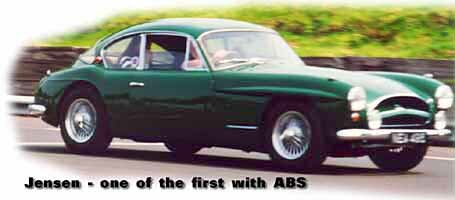
There's a parallel in the motorcycle world: Moto Guzzi's linked brakes. Again, it wasn't new - various British manufacturers had tried to link front and back brakes, via rods and cables, back in the thirties. But Moto Guzzi made the concept work, once hydraulic disc callipers and pressure-sensitive relief valves were available. It's a great system - and I do have experience of this one! You can more or less jump on the foot brake with impunity - it shares the braking effort between the back disc and one of the front discs. Squeezing the handlebar lever brings in the second front disc for even greater stopping power.
Since 1974, Moto Guzzis have had the best brakes around. Unfortunately, though, I know of a couple of long-time Guzzi riders who hit trouble when they switched to a different make of bike. One of them now walks with a permanent limp. Old habits die hard... and back brakes lock easily.
You can't take a motorcycle test on a Guzzi - its capacity is too big for a learner bike - but you can sit a car driving test in a vehicle with ABS brakes. I think that that is potentially disastrous.
There's a part of the test that I'm sure we all remember only too well. The bit when the examiner wallops the top of the dashboard - when you are expected to stop the car just as if a child had run out in front of it. And I'm sure we also remember that, for a learner, it's not necessarily easy to gauge the fine line between maximum braking and a skid.
With anti-lock brakes, though, you don't need to worry about skidding - not even on a wet road. Press the pedal as hard as you like and the car will stop without drama in the shortest possible distance. So how on earth does the examiner know whether the candidate is competent to carry out a safe emergency stop when an electronic black box is actually making all the decisions? In acar fitted with ABS, the emergency stop is reduced merely to an assessment of the candidate's reaction time.
Nowadays, the Driving Standards Agency employs a private PR company to answer awkward queries. The woman that I spoke to was relieved to hear that I didn't want to know about the new written driving test - they'd obviously had a bit of a run on that one. She rang back an hour later to give the official verdict: 'The examiner will be sufficiently experienced to know whether the car would have been under control without the benefit of the anti-lock braking device.'
I'm afraid that I don't accept it. There's a separate licence category for people who pass their test in a car with an automatic gearbox because they haven't shown whether they're capable of clutch control - and they're not allowed to drive a manual until they pass a further test. People who pass a test courtesy of 'automatic brakes' haven't shown that they're capable of brake control. As ABS becomes fitted to smaller, cheaper cars, we are going to see a whole generation of drivers who may never have had to develop real braking skills. At some stage, though, they'll find themselves in a car that lacks the magic box. Let's just pray that a child doesn't run out from the pavement...
David Landers
 Got something you want to get off your chest? E-mail your views to David Landers at
 Back to Archive Main Page

 Comments, letters, suggestions; post your E-mail to; The Editor, Classic Motor Monthly,
 Snail-mail; Classic Motor Monthly, PO Box 129, Bolton, BL3 4YQ, Lancashire, United Kingdom.
 Tel (01204) 657212; International +44 1204 657212
  Fax (01204) 62479; International +44 1204 62479