

I WONDER, IF CLASSIC Motor Monthly ever did a survey, how many readers would stipulate their dream car as having to be Italian, brand new, cost around the six figure mark - and be bright red?
Quite a few, I'd guess, but then I've knocked on the Camelot portals before. However, if you were to ask Gordon Hayes that question you'd receive a different reply. For a start, his ideal is now almost 20 years old...
It's difficult to lay down hard-and-fast criteria as to what constitutes a desirable car these days and, as time goes on, it becomes more tricky - but somewhere in the equation you'll be looking at performance. It would be a bonus to be able to add comfort and exclusivity. And if you could then squeeze in reliability and longevity, you'd really have something to write home about. Gordon, though, is familiar will all these attributes for each ane every one is present in the love of his life - and he paid just £14,500 for his 911 turbo.
The car featured in this write-up is actually a 1978 model and boasts the muscular 3.3 litre engine. It's one of the limited edition to carry the (then) sponsors in the racing scene: not too garish but prominent nonetheless, the Martini side decals single out this white car. It's a quite a mouthful, therefore, to give the car its full title and you might be forgiven for thinking that it's just another Porsche: after all, the 911 isn't an uncommon sight on these days. But you'd be overlooking a few facts in that supposition: in many ways the car (or at least the line that it sprang from) represented a new era in German development of this particular marque.
It wasn't until 1974 that the first 3 litre 911 turbo car found its way over to our shores and with it came proof positive that Europe (or more precisely Germany) was now able to take on the big boys in the supercar league. Suddenly the rule-book required re-writing: here was a solidly built and well-engineered car that could leave for dead just about any other production car of the era. That Porsche had come up with this stunning vehicle was not really surprising as the company was heavily engrossed in racing the 911 at the time and the Zuffenhausen firm were uprating them accordingly. What was staggering, though, was the fact that a supercar could be reliable, reasonably economical and was easy to drive; hitherto, fast exotica usually spelled out specialised knowledge and performance at the price of frustration.
The early cars to arrive in the UK had a four speed gearbox mated to an engine which could churn out around 260bhp. This power came courtesy of the KKK turbo and Bosch injection. Top speed touched 153mph and the firecracker would see 100mph in just 14 seconds, both adequate accomplishments with which to establish your credentials as a builder of seriously quick cars back in the early seventies. The long-legged gearing was designed to help these performance figures and better still (at least for the impecunious) were the acceptable 20-22mpg fuel consumption and the long (12,000 mile) service intervals.
Never ones to rest on their (racing) laurels, Porsche continued to tinker with the car. In 1977 the first of the 3.3 models trickled on to the market. Power was appreciably up at 300bhp and commensurate with this was the important increase in torque which won the car even more fans. A five speed box did eventually appear (in 1989), together with further increases in power output although the purist will probably opt for the slicker, earlier four speed model. With this car, the 0-100mph dash carved two seconds off the previous time... It was one of these cars that Gordon bought ten years back.
Gordon, who is in the motoring trade, has owned a mouth-watering array of vehicles over the years. An early car was the Singer Le Mans which preceded a MG J type. For a while he had twin-cam Lotus 7 which he restored (and won prizes with); he moved on to the inevitable Ferrari only a few years back. "I bought a lovely red 246 Dino. Driving it home, I'd only done five miles when the bottle screw in the gearbox went, leaving me with just first and second. It was super car, but flawed. You couldn't always get second until the box was warm and the synchromesh on third was usually short-lived, giving up the ghost after about 10,000 miles. The annoying thing was, the factory must have known about all this - but never did anything."
Small wonder, then, that he turned to Porsche. The 911, to him, represents the pinnacle although Gordon freely admits it isn't, perhaps, the most balanced package.
"It's great for power and there's little to touch it but the 2.4S and the 2.7S were probably better all-rounders," he revealed. "Once you get into the SC series, they become a bit ponderous." It's certainly refreshing to hear less than dogmatic ownership views on supercars!
The Martini cars, as they were known, emerged in the late 'seventies at the time this famous drinks company was sponsoring Porsche in their racing programme. It's not exactly a commemorative model in the sense that it was special; rather, like the JPS Lotus Europa, it merely adopted a livery for show. Under the skin the car was the same as any other 3.3 turbo, the differences lying in the discreet red/white/blue body lining and the interior which echoed the is trend. I gather that ordinary white cars were also jazzed up to copy these models. Gordon has always fancied this type and was lucky enough to secure the later-engined variant - a few 3 litre cars were also produced.
The car came with 70,000 miles on the clock and had been through several sympathetic owners. Look at it in the cold light of day and you'd be hard-pressed to isolate it from a model half its age; sure, there are odd touched up spots around the front but the finish of the vehicle is astonishing, considering its years. Little clues are abundant: the chrome rims on the wheels are not gouged, the exterior fittings are well-anchored and the inside of the wheel arches are in fine fettle. You can look at all the tell-tale areas that betray a car's age but you'll have to look hard to date this model.
The story continues inside the car. Doors open wide to disclose comfortable white and blue leather seats with contrasting red carpet. You drop down into the low seat to be confronted by a straightforward dash with a prominent tachometer - it's all very German, in other words, high organised and efficient. The steering wheel is of a pleasing diameter and chunky too; the dash is well-finished in blue leather and minor switchgear easy to read. The door shuts with a reassuring clunk, reminding you that there's no monkey-metal here.
Angling up from the floor is the gearlever and there's a large clutch-pedal where you'd expect it; it's size is not just for show because the car's enormous power demands a very strong pedal.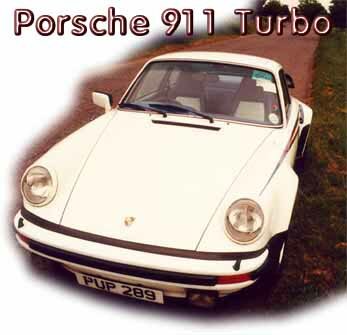
Gordon's car isn't standard, though. Behind are the vestiges of two seats, stripped out to save weight. Gone is the air-conditioning and the exhaust has been replaced by a straight through stainless system. The blower boost has been turned up to 1 bar and Gordon reckons that the whole package is capable of producing around 350bhp which, if true, puts it on a par with the latest 5 speed models. True top speed is unknown but it could well be hitting the 170mph mark, assuming that you can find enough road, that is.
Before I photographed the car, Gordon drove the 911 to illustrate what she was capable of. Whilst I was sorting out my gear the car was started and sat idling for a few minutes before we left. It was in the first straight that I began to get an inkling of what was to come. Still in first gear, a stab on the throttle and the car leapt towards the horizon at a rate that I, personally, had never experienced before. And this was repeated over and over again. It didn't seem to matter what gear we were in - the power just came on tap at 3,000rpm and the car gathered up its skirts and went. The closest thing I've seen to this would have been on television when in those space adventures you, the viewer, rush through hyper-space or whatever they call it. It wasn't exactly warp-drive but the feeling of the g-force, pushing me back on to the seat, was enough to make me thankful that I'd had a light breakfast.
I didn't say much. I'd have given a lot for a little handle on the front of the seat. I gradually became accustomed to the potential of the vehicle but remained quite overwhelmed by its abilities. And the shock didn't end there, with the acceleration, either; the 911 hugs the road like the proverbial leech, goes around corners with indecent speed (and ease) and there's not a hint of tyre squeal or any bumps or rattles. At least, I couldn't detect any. And all this from a car of an age where many of its compatriots are now in scrapyards.
The gearing on the car is a contributing factor to its brute power, of course. This 911 will reach 50 in first, push on to about 85 in second before third will take it to 130. After that, you're on your own. As mentioned, it will rocket from rest to 100mph in an amazing 12 seconds or about twice the time it takes to read this sentence. Indeed, Gordon has been taking the 911 to the Brighton Speed Trials fairly regularly since 1990 and has gained a couple of second-in-class awards. In 1990 he completed the half mile run in 20.82 seconds, attaining a terminal speed of 134mph. Now that's what you call acceleration.
I had regained my composure (and stomach) enough to photograph the car and then I was allowed my fun. The immediate problem, that of familiarisation with the gearbox, didn't occur for the four speeder is both precise and foolproof. What did require work, though, was the clutch since it has a lot of travel and needs a muscular left leg. How many women have you seen driving 911 turbos? Now you know why. On the move, engine doesn't intrude and the actual ride is very comfortable. The 911 is a wideish car though so it takes a little getting used to on minor roads. Visibility is good all round, despite that ponderous tail which can double as a useful picnic table should you get caught out on a summer's day.
The gearing was something else, with an absence of cut-and-dried power bands. I had my own turboed car for a few years but that would run out of puff at around 25mph in first and you could hear the engine telling you to change up; the Porsche, however, is seamless and however hard you push it is able to absorb it without flinching. I, too, experienced the staggering thrust from flooring the accelerator and seeing the horizon loom large. All the time, though, the 911 felt totally safe, a factor that must have endeared it to many a motorist and what must surely constitute a big selling point. And yet, the 911 would happily potter along in fourth at 40mph; as Gordon said, it's hard to simply drive the car. After all, he could go to work in first gear and lose his licence in a trice if he wasn't careful with his right foot.
Right-footing also needs care if you're a little too liberal in the tight corners, especially if it has been raining. The propensity of the 911 to turn about face when mishandled on damp tarmac is one of its little traits and owners who have performed this feat soon become attuned to a more fluid form of driving thereafter. It can be a pussycat, this 911, but it can also maul you.
Gordon reckons to have spent around £3,000 on the car since he's had it. Bills have included the exhaust, a new heat exchanger, front discs and shock absorbers. He does most of the work himself which reduces the cost of ownership; for despite, the car's fine pedigree, things do wear out. You'd be looking at tyres at around £110 a corner and the front discs, for example, cost around £100 each. That said, he recently took the engine out for examination and clutch adjustment and he was amazed to see no carbon deposits on the pistons: indeed, the whole engine was in a remarkably clean state, considering the car's 90,000 plus miles. Porsche build and quality of materials really is no myth - it's reality.
Did he have any advice for would-be purchasers? "Watch out for modified examples and always get a good look under the car - they can deteriorate. Has there been any accident damage? If so, it needs to have been properly repaired. Some left hand drive US cars have been converted to right hand drive so beware. Basically, buy as good a car as you can afford - it'll repay you in the long run."
To find a similar car today might cost you between £15,000 and £25,000 as just 50 of this model were made. That said, it's an impressive advertisement for a not-so-young car, something that will blow away the cobwebs and give you a huge grin into the bargain after only a few minutes.
And me? I'd just like to borrow the 911 for a long weekend for I know of some quiet roads in northern France that are just begging to be visited...
Alwyn Brice
 Back to Archive Main Page

 Comments, letters, suggestions; post your E-mail to; The Editor, Classic Motor Monthly,
 Snail-mail; Classic Motor Monthly, PO Box 129, Bolton, BL3 4YQ, Lancashire, United Kingdom.
 Tel (01204) 657212; International +44 1204 657212
  Fax (01204) 62479; International +44 1204 62479