
[ Classic-fied Ads On-Line | On-line Events Diary | CMM Links Page | CMM Subscriptions | Search this Site | CMM Readers Letters | CMM News Items | From the CMM Archives | CMM Clubs Listing | CMM Motor Museums Listing | CMM Homepage | Special Offers in CMM]
FOR THE VERY LATEST EVENTS NEWS - UPDATED APRIL 3 - CLICK HERE
MAKE SURE OF YOUR 2015 ALMANAC WITH A CMM SUB - SEE HERE
JULY 2015 ISSUE OF CMM MAILED OUT TO ALL SUBSCRIBERS FRIDAY, JUNE 26...
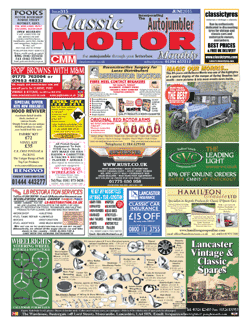 JUNE 2015 ISSUE: OUR 26th year of publication, CMM is changing, becoming bigger, bolder, brighter, now MORE PAGES, FULL COLOUR THROUGHOUT - and the 2015 Almanac, the 'bible' for enthusiasts is here!
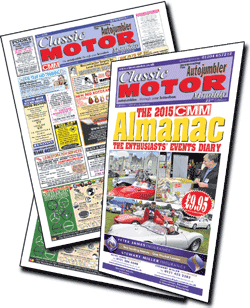
Subscribe now and you can get Britain's most comprehensive events booklet - the 2015 Almanac - from only £1.50 extra*; a genuine bargain for this essential publication! For more details on this super diary - worth up to £9.95 plus p&p alone, click here. As usual, in our latest issue - in the year where we celebrate our 26th Year of Publication - we've a run down on all that's best in the classic car world! In the June issue, On Your Marques looks at the Aston Martin Owners concours, plus a unique Volvo for sale, and more. Magpie recalls Down The Years, and in the Spannerman column the old boy talks about Spannerman & More Counterparts. Plus, our column by former National Motor Museum Curator, Michael Ware while Peter Love gives us another Love Steam and Commercial Break. There are news snippets galore, our Letters column, and our look at the world of the autojumbling with The Secret Autjumbler, and we have loads of show previews and more. We check out the big upcoming events, and take a look at Techno Classica Essen, Beaulieu Spring Autojumble, Southern Classics at Chichester, and more. Landers Lobby discusses being Caught in The 'Net, there are more Tales From The Lock Man another of Fordie's Favourites, and lots more. Look out for all the news and snippets; no better time than now to think about that subscription than the June issue!!
Our letters page has, as usual, your views on the issues of the day and more. We feature more services and spares than ever in our ads section, a look out too for Klaxon's Readers Problems, the ever-informed and controversial 'Jumblin' column, the CMM Crossword from Alvina Williams where you can win fabulous prizes courtesy of our sponsor Gunson, On Your Marques, club news, Get Set, news snippets, our fascinating 'All You Wanted to Know' column with Minerva, and the biggest events section of any publication in the U.K., featuring all the events, autojumbles, auctions and collectors swapmeets that YOU want! Why not order your copy today and get the 2015 Almanac!* CMM makes the ideal gift! For subscription info., click here!
Why not download a sample page (download is in Adobe Acrobat PDF file format - 150kb) of CMM? If you wish to download the sample page, click here.
PLUS, this and every month, 1000s bits, 100s of cars, loads of essential services for you in our Classic-fieds to wade through in our Classic Motor Mart & Autojumbler sections, and the biggest Events Diary section of any publication in Britain. Another good reason to subscribe now! You'll find a selection of last months ads, a sneak preview of this months ads, PLUS the latest ads On-line, by clicking here.
AND...subscribe NOW - using our brand new Secure Server Form - you can get FROM JUST £1.50 EXTRA , our Year 2015* Events Diary and Almanac that's worth £9.95!!
Be sure of getting the 2016 Edition FREE by staying on our mailing list* Click here to go to the secure subscriptions order form now, and don't forget to visit our events page and send us YOUR events dates. Want to know more about CMM? Get the facts here.
*DON'T FORGET - The 2016 Almanac will be sent free to all subscribers on our mailing list as of Jan 27, 2016. Join today and get your 2015 Almanac from just £1.50 extra. For more details click here. The 2015 Almanac is also available separately at £9.95 including UK postage, add £1.75 postage for Europe, £2.75 Rest of the World.
CAUGHT IN THE 'NET..."...THE INTERNET HAS CERTAINLY made the sourcing of spare parts easier, but it can bring its own particular problems. |
"...IT’S STRANGE HOW SOMETIMES you get used to something being there, and you get used to the idea that perhaps it will always be there. You come to expect more of the same. Then something slightly different comes along and you’re not quite sure what to expect.
 What am I talking about? The coalition government being replaced by a majority government? No, don’t be silly. I’m talking about Myth of the Month being usurped by SON OF MYTH OF THE MONTH! We’ve spoken about little else down at the Chequered Flag during this last month. The reason for the increased chatter is all to do with the sudden influx of information we’ve received about the impending disappearance of the driving licence counterpart. You’ll remember that the counterpart is the paper part of the licence, and it’s on this that information about the history of current and recently expired motoring convictions is recorded.
The first new development we got was a press release from The Retail Motor Industry, who represent the interests of operators in England, Wales, Northern Ireland and the Isle of Man providing sales and services to motorists and businesses. Now of course the Chequered Flag doesn’t have a hotline connecting us to such bodies, so we have to thank Mr Editor and his team for forwarding on the press release. Here’s a flavour of what they had to say:
“From 8 June 2015 the paper counterpart of the driving licence (D740) is to be abolished and will no longer be issued by the Driver and Vehicle Licensing Agency (DVLA).
“There will no longer be a need for drivers to keep the paper part of the driving licence as the photocard part will be all that is needed going forward. More sophisticated on-line systems allow data to be stored about individual motorists driving offences making the counterpart driving licence effectively redundant.”
Well that seems fairly straightforward, and confirms what we already knew. But you may recall the question that we were asking which was about the usefulness of the paper counterpart of the driving licence when hiring a vehicle. Courtesy of my trip to a local car hire office, and in particular the customer in the office who happened to work for a major insurance company, we’d been told that there was already a scheme in place whereby companies could register to access the DVLA’s driver records to check to see what convictions a driver carried. The press release didn’t let us down when it came to information about that scheme.
“Dealers need to be aware that they will need to change their procedures if they lend courtesy cars or run self-drive hire fleets where they will need to check customers entitlement to drive. DVLA offer an on-line system to check driving licences which can be accessed for free at www.gov.uk/view-driving-licence.”
But as I read the information, something struck me. It doesn’t say anything about this service being for motor dealers only. So could I check my own licence? Or anyone else’s, for that matter? Even my still relatively limited computer skills allowed me to search the world wide web for this source of driving licence information. And when I say relatively limited skills, I reinforced that as I received the message “Cannot display the web page”. Ah well, maybe it is just for dealers. So I returned to reading the press release, and I saw what I consider to be a rather curious thing.
“Counterparts after 8 June 2015 will no longer have legal status and motorists are advised to destroy their counterpart after this date.” That seems fair enough, but it continued: “..the changes to the counterpart licence affect the UK only and if drivers are going aboard they need to check the licence requirements for each country before hiring a vehicle.” Now what on earth does that mean? The first part is quite clear. By the middle of June we should all have destroyed our paper counterpart licences. But as we read on, that only seems to apply to the UK, so if in early July we want to go abroad, are we expected to piece back together the ripped up paper counterpart..?
Read the full article in the current issue out now!
CAR RESEARCH IS FASCINATINGI JUST LOVE GETTING INVOLVED in researching the history of a car.Here is one story whose history took us completely by surprise. The 4th Earl of Craven was an early enthusiast for the motor car, owning a number of powerful Daimlers amongst other cars. It is known he had a 1902 2 seater with mother-in-law seat, a 1904 28/36 and in 1906 a 30/40 landaulette with body by Rothschild et Fils of Paris. The registered owner of this car was Cornelia Countess of Craven. I have recently been to see my friend and restorer Richard Peskett who has been working on another of the Earl’s cars a 1907 50hp Daimler, previously owned by watch maker and Isle of Man resident George Daniels. The present owner Nick Whitaker, when researching the history of this car, found a photograph album previously the property of William Billingham, chauffeur to the Craven family. In it were several pictures of his cars. On the strength of the work that Richard had done on this Daimler, Japanese Antique dealer Mr Ugai brought to Richard a 1906 Daimler 5 seat tourer to be refurbished and brought back to an MOT standard. This large car intrigued Richard as he was convinced that the body was not the original, it was not of the standard of the period, though the chassis, engine and running gear appeared all to be very original indeed. It was the wings and the body that did not look right to his experienced eye. Looking through the photographs again he noticed that the registration on the car in his workshops, AC 752, was the same as the landaulette from the photograph album. This convinced Richard that the car has been rebodied at some time, possibly in the 1950’s or 1960’s. but by whom and why? We set to work to find out. The present owner knew little of its history except that he was the third owner in recent years all in Japan. it was reputed to have come to Japan from Hawaii. I knew there was once a famous collection of cars in Honolulu owner by a Mr. Sullivan that had been auctioned years ago. I turned to Stewart Skilbeck who has been in the car auction business for years. I struck lucky as he had written the catalogue for the Sullivan sale conducted by Sothebys in 1991. He told me that the car in question was not in the collection when he catalogued it, but that three cars including a veteran Daimler had been bought by a collector in Japan. Sullivan had previously lived in Southern Ireland where he had made his money from a chain of supermarkets. One of his best friends was Dennis Lucey from Portlaoise who had a collection of cars on show at his Motor Museum in Killarney. He bought and sold a lot of cars to Sullivan, especially after Sullivan had retired to Hawaii. Stewart Skilbeck was intrigued by my enquiry re AC 752 and in his records found it listed as Lot 37 in the auction catalogue of the A.W.F.Smith collection at Cross in Hand in 1968. It was described as “1905 Daimler 30/40 hp chassis - VCC dated and some restoration work has been done”. Later this chassis was withdrawn from the sale as I had been part of the Veteran Car Club’s Acquisition Scheme. During the war if a veteran car was known to be in danger of being scrapped it was bought by the Club and after the war passed on to a suitable member. One of the covenants placed on the car was that if it was ever sold it should first be offered back to the Club. The A.W.F.Smith executors obviously did not know of this embargo on the chassis. I had taken the photographs for the Sotheby auction catalogue, but looking back through the negatives I see I was not asked to photograph this chassis..! Wareabouts - read the full article in the current issue out now! |
 Comments, letters, suggestions; post your E-mail to; The Editor, Classic Motor Monthly,
 Snail-mail; Classic Motor Monthly, P.O. Box 129, Bolton, BL3 4YQ, Lancashire, United Kingdom.
 Tel (01204) 657212; International +44 1204 657212
  Fax (01204) 652764; International +44 1204 652764
| C | M | M |